How to Create a Simple One-Page Life Plan in Under 2 Hours
Why a One-Page Life Plan Works (And Why You Don’t Need a 50-Page Journal)
Last Sunday, I sat at my kitchen table with a stack of half-filled planners, three abandoned bullet journals, and a faint sense of guilt. I’d spent over $150 on “life design” workbooks that promised clarity but delivered homework. The irony: I was so busy planning that I never actually lived the plan. So I grabbed a single sheet of A4 paper, set a timer for two hours, and forced myself to finish before the coffee went cold. That sheet—just one page—has guided my decisions ever since. Here’s why the one-page life plan beats any 50-page journal: it fights decision fatigue. When you have only one page, you cannot bury your priorities in detail. You must choose what truly matters. Psychologists call this the paradox of choice—more options often lead to paralysis, not freedom. A one-page plan acts as a forced filter: if it doesn’t fit on the page, it doesn’t fit in your life right now. That constraint is liberating. The second reason is focus. Every time you open a bulky planner, your brain scans dozens of unused sections, draining willpower before you start. One page gives your mind a single, clean decision point. In my own setup, I now keep my one-page plan magnetized to the fridge and a digital copy on my phone lock screen. It takes less than ten seconds to glance at my values and top goals. That glance has stopped me from saying yes to three projects I didn’t actually care about—and that alone saved me dozens of hours. So before you buy another journal, try this: one page, two hours, real results.
I’ll walk you through the exact steps I used, starting with the foundation that keeps you honest.
Step 1: Define Your Core Values (The Foundation That Keeps You Honest)
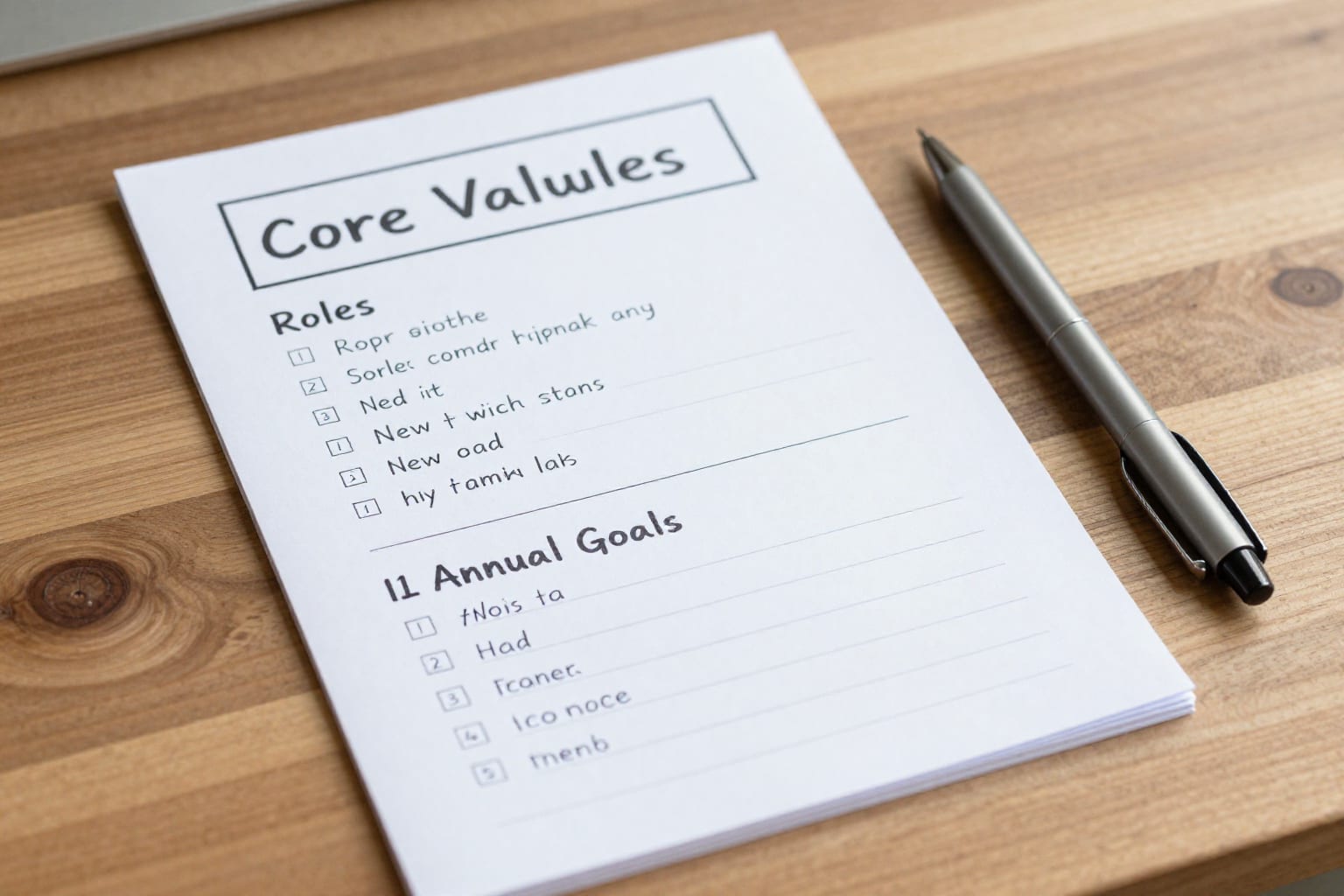
I once listed “adventure” as a top value because it sounded cool on Instagram. But when I looked at my actual calendar, I spent zero weekends outdoors. That mismatch is why values must come first—they anchor your plan in truth, not aspiration. For this step, grab your single sheet of paper and a pen. No apps, no digital distractions. Draw a small box at the top left and label it “Core Values.” Now, set a timer for 15 minutes. Pick from a short list of common values: family, growth, health, freedom, creativity, security, community, integrity, adventure, contribution, learning, spirituality, connection, autonomy, excellence, balance, simplicity, courage, fun, impact. Circle only those that genuinely make your chest tighten when you read them. Then narrow to 3–5. Yes, only 3–5. If you circle ten, you are lying to yourself—you cannot prioritize ten things at once. In my own plan, I landed on family, growth, health, and contribution. That last one surprised me. I hadn’t realized how much I needed a sense of giving back until I forced myself to choose. Writing those four words changed my entire goal list. For example, “growth” meant I stopped saying yes to every networking event and started investing in one deep skill per quarter. The key here is honesty, not impressiveness. Your values are for you, not for anyone else. If your list includes “security” but you secretly crave risk, that tension will show up in every goal you set. So trust your gut. If a value feels right in your stomach, keep it. If it feels like something you “should” value, cross it out. Once you have your 3–5 values, write them in bold letters. This box becomes your compass. Every goal you set in the next steps must align with at least one of these values. If it doesn’t, it gets cut. No exceptions.
Step 2: Map Your Big-Picture Roles and Long-Term Vision (30,000-Foot View)
Now that your values are set, it’s time to look at the big picture. I want you to identify 4–6 key roles you play in life. Think of them as hats you wear: professional, parent, partner, friend, learner, health seeker, community member, creative, household manager. List them on your page in a second box labeled “Roles & 5-Year Vision.” For each role, write a single sentence describing your ideal version in five years. Not a paragraph. One sentence. Concrete but brief. For example, under “Professional,” I wrote: “I run a business that serves 500 clients yearly while working 30 hours a week.” Under “Parent”: “I attend every school event and have dinner with my kids five nights a week.” Under “Health”: “I exercise four times a week and sleep 7+ hours nightly.” Notice I didn’t say “be a great parent” or “stay healthy.” Those are too vague. The one-sentence constraint forces you to imagine a specific scene. When I wrote “dinner five nights a week,” I could picture it. That picture gave me motivation. Here’s the trick: don’t worry about feasibility yet. Just paint the ideal. You will trim later. The purpose of this step is to create a destination that excites you enough to take action. If your five-year vision bores you, your one-year goals will feel like chores. So dream a little. But keep it to one page. If you find yourself writing a paragraph, stop. Shorten it. Remember: this entire plan fits on one sheet of paper. The roles and visions should take no more than three lines each. For instance, my entire roles section looks like:
- Professional: Profitable business, 30-hour weeks, 500 clients.
- Parent: Dinners, school events, weekend hikes.
- Health: 4x/week exercise, 7+ hours sleep.
- Friend: Monthly deep conversations with two close friends.
That’s it. Four roles, four single-line visions. That took me about 20 minutes to draft and refine. The constraint felt uncomfortable at first, but it forced me to choose what mattered most. If you struggle, ask yourself: “If I could only keep three roles for the next five years, which would I choose?” That question cuts the noise.
Step 3: Break Down Your Vision into 3–5 Annual Goals (The Action Bridge)
Now the plan gets real. Take each role’s five-year vision and ask: “What one or two specific things can I accomplish in the next 12 months to move toward that?” Write those down in a third box labeled “Annual Goals.” But here’s the critical rule: you may only keep 3–5 goals total across all roles. Yes, total. Not per role. If you have four roles and you list two goals each, that’s eight. Cut to five. I know, it hurts. But remember the one-page constraint: if everything is a priority, nothing is. When I first did this, I had eight goals. I spent an hour trimming. I asked myself: “Which goal, if I achieved it, would make the biggest difference toward my five-year vision?” I kept two that were non-negotiable (grow revenue to $120K and exercise 3x/week) and added three others that were high-leverage (read 12 books, volunteer quarterly, have one monthly date night). I cut “learn Spanish” because it didn’t align with any current role vision. I could add it next year. Notice what I did: I didn’t cut based on difficulty; I cut based on alignment with my values and long-term vision. That’s the bridge. Your annual goals should be specific enough to measure. Instead of “be healthier,” write “run 5K in under 28 minutes by December.” Instead of “grow my career,” write “complete a project management certification by June.” Each goal gets its own line. If it takes more than one line, it’s too complex. For example, my annual goals section looks like this:
- Revenue: $120K from coaching clients.
- Health: Run 5K under 28 min.
- Learning: Read 12 books (1/month).
- Contribution: Volunteer at food bank quarterly.
- Relationship: One date night per month.
That’s it. Five lines. I wrote them in under 30 minutes. The hardest part was leaving out “write a book” because I knew I didn’t have the bandwidth. But that’s okay—the plan is a compass, not a to-do list. If I finish my five goals in six months, I can add one more. But I won’t. I’ll use the margin to deepen my health and relationships.
Step 4: Design Your Weekly and Daily Check-In Ritual (The 10-Minute Habit That Keeps You on Track)
Your one-page plan is useless if it sits in a drawer. I learned this the hard way. After my first draft, I tucked it into a notebook and forgot it for three weeks. So I built a ritual that takes exactly ten minutes every Sunday evening. Here’s the template: grab your one-page plan (or open the digital version). Ask three questions:
- Which annual goal did I make progress on this week? Write a single sentence.
- Which goal got neglected? Write one sentence about why (without guilt).
- What is my single most important action for next week? Write one action.
Practical Takeaway: Your one-page life plan is not a static document. It’s a living compass that you refine quarterly and check weekly. Print it, pin it, and let it guide your decisions without guilt. In under two hours, you can draft a plan that saves you weeks of indecision. That’s a trade-off worth making.